
Home Investigation: When the Body Drives Design
The somatic scaffolding of your living space

I’ve been doing small brief talks lately and I always recognize the when an idea resonates with participants. One idea that I always come back to and makes eyebrows raise is how our homes quietly shape the way we feel, function, and return to ourselves. We often talk about somatics, healing, and the nervous system, but we rarely talk about the architecture we are living inside. Most Western homes lean toward straight lines and sharp angles, which are expressions of yang energetics. They are efficient and orderly, yet they are not always what the body naturally softens around. When I ask people to describe their homes I ask how it feels before I ask what’s in it.
Our bodies are not angular. They are curved, fluid, soft, and rhythmic. We are made of spirals, waves, branching patterns, and organic lines. When we spend our days inside rigid, boxy spaces, something in us may subtly brace. We may not always notice it consciously, but our physiology often does. Our wellness is a continuum and our built environment has a noticeable impact on it.
Somatic inquiry invites us to notice how the body responds to safety, movement, breath, and environment. We are reminded that the body often finds ease through flow, responsiveness, and the gentle containment that nature can offer. Yet many modern structures emphasize straight lines, hard grids, and architectural uniformity. These spaces function, but they do not always support the natural ways the body experiences ease, orientation, or safety. Introducing softness and curves back into a space is not only a design choice. It is a way of cultivating a more attuned relationship with your internal world.
It is also important to acknowledge that how we perceive space is shaped by culture and historical experience. For some people, open layouts feel liberating and communal. For others, too much openness mirrors histories of surveillance, displacement, or environments that never offered privacy or protection. Feng Shui offers beautiful insight, but even it can overlook the complexity of cultural narratives, trauma histories, and the different meanings that containment or openness have across groups. A supportive home must always be understood in context, because no design principle exists outside of culture, identity, and memory.
Your nervous system is always reacting to the world around you
Through neuroception, the autonomic nervous system is constantly scanning for cues of safety or threat, and that scan is shaped by lived experience. Harsh lines, clutter, sharp edges, and cold materials can signal alertness, especially for bodies with histories of vigilance. Warm textures, natural light, organic shapes, and visual harmony can send a quieter message that your body may soften here. As a long-time stroke-survivor in a very hypervigilant and often fatigued body there are things in my home that support me daily. Soft textures are a must. Clear (no clutter) hallways and floors are also non-negotiable. (I have a body that is uneven and falls are always a concern.) Balanced lighting; walking into a dark room will immediately activate me. The air quality and temperature of my home is also relevant to how well my body is responding on a given day (this can be a small bone of contention that has to constantly be negotiated.) My body is constantly scanning for safety and threat. Attuning to my home helps lessen this heavy lifting.
Rooms dominated by straight hallways, rectangles, and rigid furniture can subtly contract the body. Even when nothing is wrong, the space may not offer enough cues of restoration or orientation. Curved shapes evoke something different. They echo the forms we recognize from the body and nature, including bones and fascia, river bends, the womb, and rolling landscapes. They can feel alive and familiar.
A home becomes part of your system of support. Changing even a single element of a room can shift the way your body orients itself. A round mirror, a curved lamp, a circular table, or a softer rug can provide a sense of settling. A home does not need perfection. It needs to welcome your body as it is, which is curved, dynamic, rhythmic, and organic.
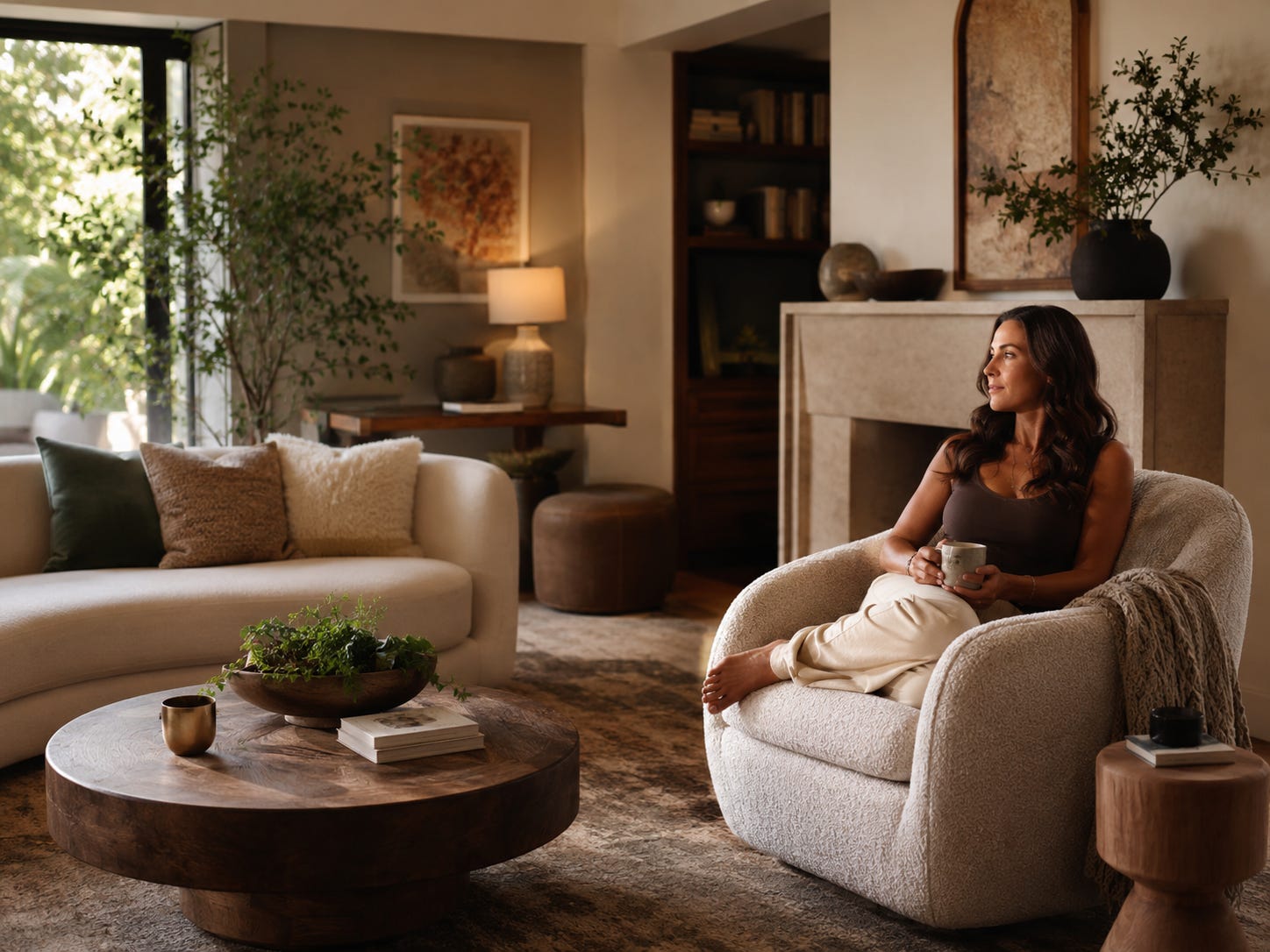
A home can help your body build agency
A supportive home is not meant to keep you calm all the time. Calm is valuable, but it is not the only marker of nervous system health. From a nervous system perspective, regulation is not the absence of activation. It is the ability to move through activation or pattern with enough capacity, relative safety, and choice. Your home can become a landing spot that allows you to feel more of yourself without becoming overwhelmed by what you feel.
Nervous system pattern awareness cannot happen without capacity. When the body is outside its window of tolerance, awareness can feel like too much information arriving too quickly. In that state, the body may move into protection, urgency, shutdown, or collapse. A home that offers reliable cues of orientation, privacy, texture, rhythm, and containment can create enough relative safety for awareness to become possible. It can help the body notice its patterns without immediately being consumed by them.
This is where agency becomes essential. Agency is not control over every feeling or every state. It is the lived sense that you have options. A chair near a window can offer a place to orient when your body feels activated. A defined corner can become a place to pause before responding. A clear pathway can support movement when energy wants to mobilize. A soft surface can receive you when your system needs downshifting. These design choices do not force the nervous system into calm. They give the body somewhere to go with what is already happening.
Homes help build agency when they make choice more available. They can invite you to ask what your body needs now, rather than assuming that every state needs to be soothed away. Sometimes the body needs quiet. Sometimes it needs brightness, sound, movement, warmth, pressure, or space. A truly supportive home can hold the full range of activation, from tenderness to vitality, from grief to momentum, and from protection to connection.
Your living space offers somatic cues
In somatic work, we learn that the body expresses emotion and memory through shape, including tension, collapse, expansion, and contraction. Homes express emotion and memory through shape as well. A cluttered entry can feel like a tight chest, while a windowless office can mirror shallow breathing. A sharp and overstructured bedroom can feel like a clenched jaw, while a bathroom with curves and warmth can feel like an exhale. An open floor plan or tall ceiling can create a feeling of exposure when the body is searching for grounding.
When you shift the shape of a room, you shift the shape your body can take inside it. The external architecture becomes somatic architecture, and rooms become metaphors for sensation. A tight space may show you where your body is bracing. A room that feels like a held breath may reveal where more flow is needed. A space that feels like a long exhale may show you what your system recognizes as support. Design becomes a form of somatic inquiry when it helps you listen to what your body is already communicating.
The Bagua Map can offer insight, but it is not complete
The Feng Shui Bagua map divides a home into nine energetic zones, including health, wealth, relationships, creativity, and grounding. It acts like a symbolic body scan. The center reflects overall health, the back left relates to nourishment and metabolizing life, the front center speaks to movement and direction, and the right side represents relationships and communication.
When applied thoughtfully, the Feng Shui bagua, or energy map, can offer a meaningful way to notice how your home interacts with your inner life. At the same time, it is helpful to approach any design framework with context and care. Feng Shui comes from a rich cultural tradition with its own worldview, and not every interpretation will resonate with every body, home, or history. Our relationship to space is shaped by culture, memory, family patterns, and lived experience. For some people, openness may feel expansive and freeing. For others, too much openness may feel exposing or ungrounding. Minimalism may feel peaceful to one person and echo deprivation for another. Feng Shui offers beautiful wisdom, but it does not need to be treated as a universal nervous system map. Design and nervous system support are never one-size-fits-all. It becomes most supportive when it is adapted with sensitivity toward past lived experience, personal agency, and respect for the body’s unique sense of safety.
Containment matters as much as openness
The issue is not always rigidity. Sometimes a home is so open concept that the body has nowhere to land. Large, undefined rooms can create a sense of chaos or exposure, especially for those whose histories have required vigilance or self-protection.
Defined seating areas, rugs, clusters of furniture, textiles, and screens can create gentle boundaries that allow the nervous system to orient. This kind of containment is not about restriction. It is about giving the body enough structure to know where it is. Bodies need both space and structure, and what that looks like varies dramatically depending on cultural background and personal history.
Containment can also support agency. When a room has clear places for rest, movement, connection, and solitude, the body does not have to work as hard to locate a next step. The environment begins to offer choices. It can say that you can pause here, move there, soften in this corner, or gather yourself before reentering the world. In this way, design supports the nervous system not by managing it, but by helping it find relationship with itself.
A home can meet all your states
Curved forms continue to offer support because they soften tension and evoke nature. But homes should not only soothe. A thriving nervous system engages in pendulation, which is the movement between activation and ease. Some people need more mobilizing elements, including color, brightness, pattern, or defined pathways that spark momentum. Calm is not the only goal. Some bodies need uplift and complexity. This is the piece that I believe current Feng Shui theory misses; it wants to add calm and minimalism where it could also offer the complexity of the 5 elements that supports rich activation and thought.

A supportive home understands the full range of human physiology and experience. Clearing a crowded entry can open a sense of possibility. Adding definition to an overly open room can create grounding. Warm lighting may nurture, while bright light may energize. Natural materials can comfort, while bold textures may awaken. These choices can help the body practice moving between states with more steadiness and less fear.
Rooms are not static. They respond to you. A room can meet you where you are when you feel scattered, and it can offer energy when you feel flat. It can reflect your culture, your story, and your history. It can also help you notice what state you are in, which gives you more room to choose how you want to meet that state.
A home can hold your whole self
Your home is a living ecosystem interacting with your inner one. Nervous system awareness helps us understand how we shift through states of connection, activation, and protection. Somatic wisdom shows how deeply we respond to shape, space, and rhythm. Cultural and historical context reminds us that our responses do not emerge in a vacuum, because they are shaped by the experiences our families and communities have carried.
When these understandings come together, it becomes clear that a home is not meant to keep you in one state. It is meant to accompany you through all of them. A home can offer a landing spot where activation does not have to be feared, rushed, or suppressed. It can give the body enough relative safety to feel what is present, enough capacity to stay in relationship with sensation, and enough agency to choose what support comes next.
A home that can hold your full range becomes a partner. It softens when you collapse, steadies you when you seek orientation, and enlivens you when you are ready to mobilize. It offers enough structure to contain you and enough spaciousness to let you grow. It honors your memories, your identity, your lineage, and your body’s unique rhythms..
In this way, your living space becomes a place where your whole self is acknowledged. It becomes a space where nervous system pattern awareness can emerge with more compassion, because your body is not being asked to perform calm. It is being invited into relationship, responsiveness, and choice. From that place, your life can unfold with the same intelligence and adaptability that lives within your own body. And if we are to offer “as above, so below” in our Feng Shui theory, we have to acknowledge that this requires exploring both the visual/brain/decor and the feelings and sensations in our bodies.
Powerful and thought provoking