
How Productivity Language Affects Your Living Space
Calm Spaces Can Feel Hard

In the West and on Instagram, clutter clearing is often framed as a discipline problem. The quiet message is that if you were more focused, more consistent, or more motivated, your home would finally stay in order. We borrow productivity language and apply it to living spaces, as if your environment is a project to manage instead of a place to live.
That mindset makes sense in a culture that celebrates constant output. Many Western decluttering approaches are yang by nature. They are decisive, fast, goal-driven, and fueled by willpower. They focus on action, momentum, and visible results. Sometimes that is exactly what helps, especially when you need a clear reset or a fresh start.
However, when clutter is persistent, emotionally loaded, or followed by a familiar cycle of purging and re-accumulating, the issue is not always a lack of discipline. Often, the deeper concern is that the home is being treated like something to conquer rather than something to care for. In those moments, what your space may need is not more yang. It may need yin, which means connection, receptivity, slowness, and the kind of attunement that creates real belonging.
Clutter Is Not Always a Mess. Sometimes It Is an Attempt at Belonging.
One of the most helpful approaches is this: Clutter is not necessarily a failure. It is often an attempt to belong.
Homes are not neutral containers. They hold memory, continuity, and identity. They carry attachment histories, grief, transitions, and parts of ourselves that are still integrating. During seasons like loss, illness, migration, reinvention, aging, parenting, or sustained overwhelm, clutter can become a record of what felt too meaningful, too uncertain, or too tender to release.
When life feels unpredictable, the body looks for anchors. Safety is not only an idea you think your way into. Safety is also interception. Your nervous system scans for familiarity, stability, and cues that signal you can settle. In that context, stacks of books, unfinished projects, clothes from a former chapter, inherited furniture, paper trails, and sentimental objects are not random. They can function like continuity markers that reassure you that you still exist across change.
From an attachment perspective, objects can also step in when human connection has been inconsistent, ruptured, or lost. For some people, letting go can feel like abandonment. For others, possessions offer stability without the risks that come with needing someone. This is one reason decluttering can bring up grief, anxiety, or shame that feels disproportionate to the pile itself. You are not only negotiating space. You are negotiating identity.
Why Decluttering Can Feel Hard to Your Body
If you have ever felt your heart race while sorting a closet, or felt suddenly exhausted after making progress, you are not being dramatic. Your home is a sensory environment. Visual noise, crowded surfaces, unfinished stacks, and emotionally charged items can keep your system subtly activated, even when you are not consciously thinking about them. A cluttered room can feel like living inside a running list of demands, and your body registers that pressure.
Many popular decluttering methods accidentally signal the nervous system that there is urgency. Advice that emphasizes speed, detachment, and relentless decision-making can backfire for anyone already carrying chronic stress, burnout, anxiety, or a trauma-shaped nervous system. In those states, the brain and body conserve resources. Decision-making becomes harder, emotional reactivity rises, and the urge to shut down increases.
This is where it helps to remember a core truth: the nervous system naturally pendulates. It moves in rhythms between activation and settling, between engagement and rest, between effort and recovery. The goal is not to feel one way all the time. The goal is to work with the rhythm so you can move through a task without getting stuck in overdrive or collapse.
Order that is created while pushing past your limits often does not last, not because you are weak, but because your system is trying to protect you. Sustainable change come from environments and processes that support regulation, flexibility, and recovery.
The Evening Version of You Deserves a Different Home
Many homes are designed for the daytime version of life. They are optimized for task lighting, productivity, and “looking clean” instead of supporting how people actually feel after a long day. That can create a mismatch because the evening version of you is not the same as the daytime version.
A lot of contemporary lighting and layout choices prioritize visibility over livability. We end up with kitchens that read like offices, bathrooms that feel clinical, and dining spaces that look polished but do not invite anyone to linger. The result is a home that performs well visually, but does not always support how people want to feel at night.
At night, people are often carrying the day. They want to come back to themselves, decompress, and feel supported. They want the home to stop asking questions and start offering answers. When the environment is too bright, too exposed, or too visually busy, the body can stay responsive or vililant when it actually needs a softer landing.
This is one of the places where informed design and Feng Shui overlap in a grounded way. Both ask how an environment affects the human experience, not just how it photographs. A supportive home is not only organized. It helps you shift states. It makes it easier to engage when you need to, and easier to recover.
We Have Normalized Environments That Keep the Body on Guard
There is a quiet kind of activation which we have normalized in modern interiors: spaces that demand alertness at the wrong times. Kitchens that feel like workstations. Bathrooms that jolt you awake when you want to wind down. Dining spaces that look good on camera but feel emotionally flat in person.
This is not just aesthetic. It is sensory. Light is information. It influences alertness, mood, and the body’s sense of time. Bright overhead lighting and reflective surfaces can increase glare and visual tension. When your eyes are working hard to adapt, your body often stays more activated. Even if you cannot name it, you might notice it as irritability, restlessness, or a sense that you cannot fully land.
Interiors often prioritize brightness, efficiency, and a polished look, but those same choices can keep the body in work mode long after the day is over. When a kitchen is lit and organized like a workstation, it can start to feel like a production line instead of a gathering place. When a bathroom is bright and reflective in a clinical way, it can signal “wake up” at the very time you are trying to wind down. Even dining spaces can be styled to look finished on camera while still feeling oddly flat when you are actually sitting there, which is why design that supports real nervous system rhythms has to focus on livability, not just visibility.
If you want a home that supports clutter clearing in a lasting way, lighting matters because it shapes the state you bring into the room. It is easier to make thoughtful decisions in a space that does not put your body on guard.
A Science-Based Lighting Shift That Supports Better Rhythms
“Light isn’t just decorative. It’s not just about visibility. It’s about biology, psychology, and dignity.” – Dr Shelley James (The Light Lady)
Try thinking of lighting as a team effort, not a single ceiling fixture doing all the work. At night especially, our eyes and brain feel better in spaces where brightness is spread out and closer to where we actually live—sitting, reading, talking, or winding down. A strong starting point is the “near space” around you (within a few feet of your body). If that area has a gentle, warm glow, the whole room usually feels calmer and more usable, and you don’t have to rely on harsh overhead light.
A good way to build this is to include a few different light placements that quietly guide the eye. Something taller helps the room feel more open because your gaze has a place to move upward. This could be a floor lamp with a shade, a tall plant lit from the side, or even light catching on a curtain or textured wall. Then add light at a lower, everyday height so the room feels grounded—like a small lamp on a side table, a warm light on a console, or a soft lamp near the sofa. Finally, include one small “purpose” light that feels intentional rather than bright, such as a reading light by a chair, a candle-like glow, or a subtle light aimed at art. That little point of focus adds direction and softness without overstimulating you.
When lighting is layered like this, it doesn’t force one vibe. It gives you options. You can come down from a busy day, support rest, or switch into focus and connection, just by choosing which lights you turn on.
“The position and the optics or ‘focus’ of the light also shapes our experience of a space and our position in it. For example, glare or dazzle from a focused light source in the line of vision creates a sense of vulnerability and tension, a uniform spread of light from a diffuse source creates a sense of being in a public space and discourages intimate conversations. Non-uniform lighting creates intimacy. Complex lighting is perceived as pleasant, while a combination of overhead & edge lighting creates an experience of spaciousness…”
“The Power of Light to Change Your Mind.” LinkedIn, 28 May 2020, https://www.linkedin.com/pulse/power-light-change-your-mind-dr-shelley-james/
Yin Decluttering Starts With the Person, Not the Pile
A yang approach asks, “What can I eliminate quickly to get a result?” A yin approach asks, “What does my body need here, and what is my relationship with this space?” Yin is slower because it is attuned, not because it is weak.
In my work, I often start with a few human questions before we touch a single bin. These questions are practical because they reveal how the space is actually used, where friction lives, and what kind of support the nervous system is asking for.
I ask clients to describe their first ten minutes at home. I want the real version, not the aspirational one. I ask where they go when they want to feel better, because that spot is often the emotional center of the home. I ask what they do when the house is quiet, because that reveals the rhythms we should design for. I ask what instantly irritates them at night, because glare, exposed sources, harsh reflections, and clutter that becomes visually amplified by lighting are all solvable. I ask what one feeling they want the room to offer, because clarity begins with naming what support looks like for them.
When you begin here, decluttering stops being a moral performance and becomes a design problem with a human solution. You stop chasing perfect order and start building conditions that make order easier to maintain.
Minimalism has helped many people, and it can be genuinely freeing. The risk is when minimalism becomes a moral identity or a form of self-erasure. If the cleanest space is treated as the most evolved space, then any fullness can feel like failure. For some nervous systems, that becomes another pressure loop.
A more supportive approach asks a different question. Instead of asking, “How little can I live with?” it asks, “What supports my whole life?” Wholeness is not about emptiness. It is about coherence. Different bodies and different seasons need different environments. Some people thrive in visual simplicity. Others thrive in layered warmth and sensory richness. The goal is not to meet an aesthetic standard. The goal is to build a home that supports your natural rhythms.
Clutter becomes heavy when it represents a frozen relationship instead of a living one. Items that are used, loved, and honored often feel alive in a home. Items held out of fear, guilt, grief, or unfinished identity work can start to feel stagnant. A yin-based approach does not demand instant detachment. It asks whether the relationship is supportive, and whether the home has enough steadiness to release what no longer fits.
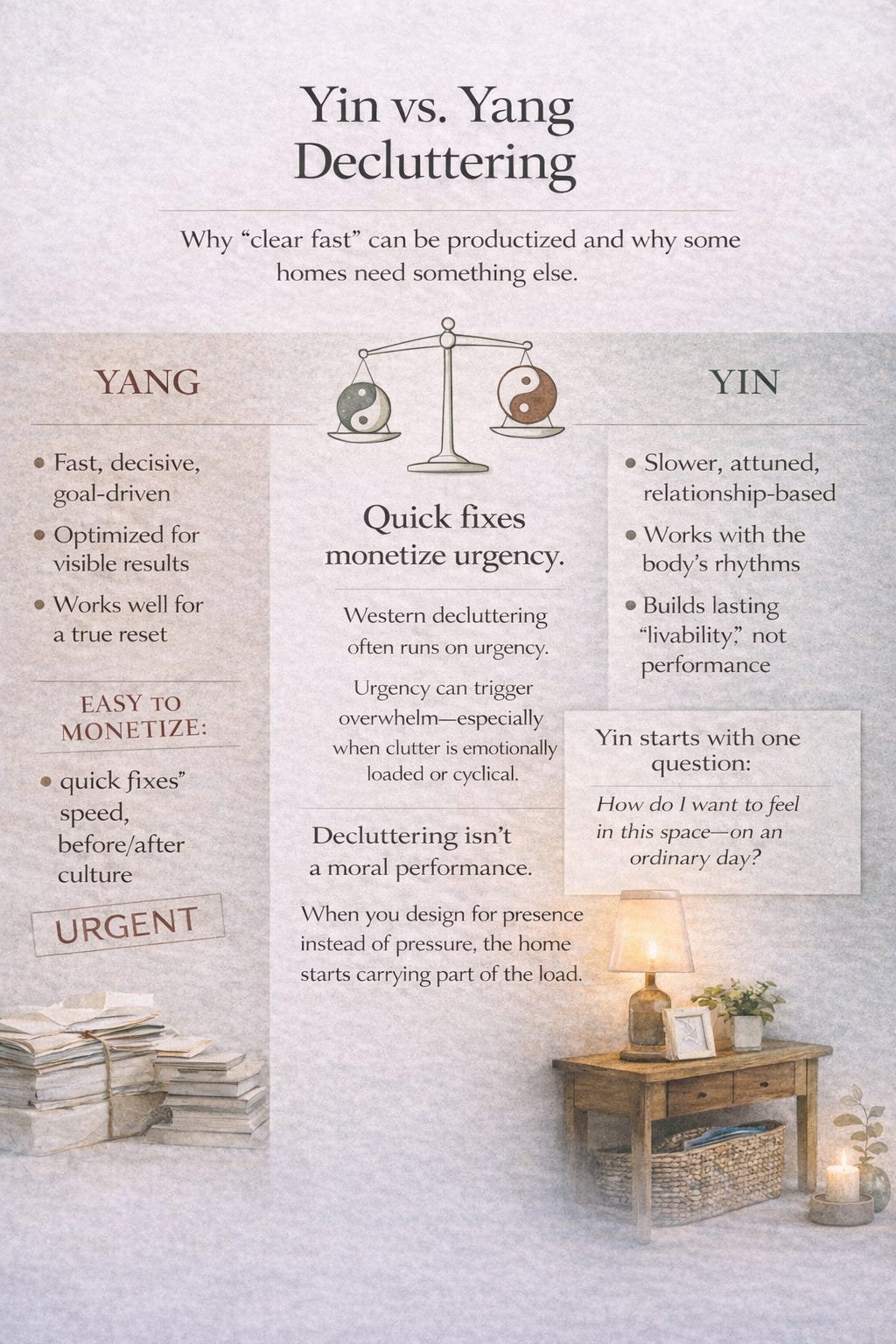
Yin decluttering starts with one grounded question: “How do I want to feel in this space, realistically, every day?” That question is not about creating a room that looks impressive to strangers. It is about shaping a space that supports your nervous system and fits the real rhythm of your life. Agency matters here because it means you choose what stays, what goes, and what gets easier based on your actual needs, not outside standards or an ideal version of yourself. When you use comfort, ease, and capacity as your guide, the space becomes something you live in, not something you perform.
Then you choose one small area that you touch often, because daily friction points are where support matters most. As you clear, you track your state. When you notice urgency, bracing, shame, or fatigue, you slow down and return to pacing that supports you. You do not push through overwhelm and call it progress. You create conditions that let your nervous system pendulate naturally so you can engage, pause, recover, and re-engage.
Many people discover that what they have been calling messiness is sometimes self-protection. Clutter has been holding something. When you approach it with force, it tightens. When you approach it with attunement and connection, it softens.
If your home has started to feel stressful, it does not mean you are doing something wrong. It often means the environment is asking more of relationship, decision-making, and sensory system than you have available. When the brain has to keep scanning for where things go, navigating obstacles, or adapting to harsh light and visual noise, it can stay in a low-level state of alertness. A gentler approach is to shift the goal from “constant decluttering” to agency, which means you get to choose how the space supports you and what is realistic to maintain in this season of life.
When you design for real life rather than performance, the space can start supporting you back. Softer, layered lighting reduces glare and visual strain. Clearer pathways lower friction and make movement feel simpler. Realistic landing zones reduce the number of small decisions your brain has to make throughout the day. Over time, these changes help you move from repeatedly resetting the mess to building a home with steadier cues and systems, so you are not always starting over and you can spend more time living in the space instead of managing it.
A supportive home doesn’t try to hold you in one emotional state. It works with the way the body naturally shifts across the day by reducing unnecessary sensory demand and cognitive load. When lighting, sound, temperature, and visual clutter stay in a calmer range, the brain has fewer signals to filter, which can lower stress arousal and make it easier to transition between effort and recovery. In design terms, the space offers clear cues and low-friction routines, so daily upkeep requires less mental effort. Over time, that kind of environment is often what keeps a home consistently supportive.
I did a big tidy and clean in my studio space, where I work, over the weekend. Which highlighted 'piles' that I had already created to go through, and now there are more. I'm allowing myself to let them be there (for now). As I know that most have served their purpose.