
Shifting from Control to Co-Regulation
When the built environment carries part of the perceptual and relational load, people are free to arrive as they are

Connection is often described as something we create through interaction. We speak, respond, and make ourselves visible in order to feel included. Design tells a quieter and often more accurate story. Long before conversation begins, the body is already in dialogue with space. The nervous system is constantly orienting, reading light, sound, distance, texture, and containment to determine how much effort it will take to stay present. Presence is not something we perform. It is a physiological state that emerges when the environment supports regulation.
At the center of this process is the brain’s filtering system, described as the reticular activating system. It continuously decides what sensory information deserves attention and what can fade into the background. When an environment is chaotic, harsh, or unpredictable, this system stays highly engaged, scanning and prioritizing input. Attention becomes effortful. When sensory input is coherent and patterned, the brain can relax its filtering. Awareness widens without strain. Presence becomes available without focus being forced.
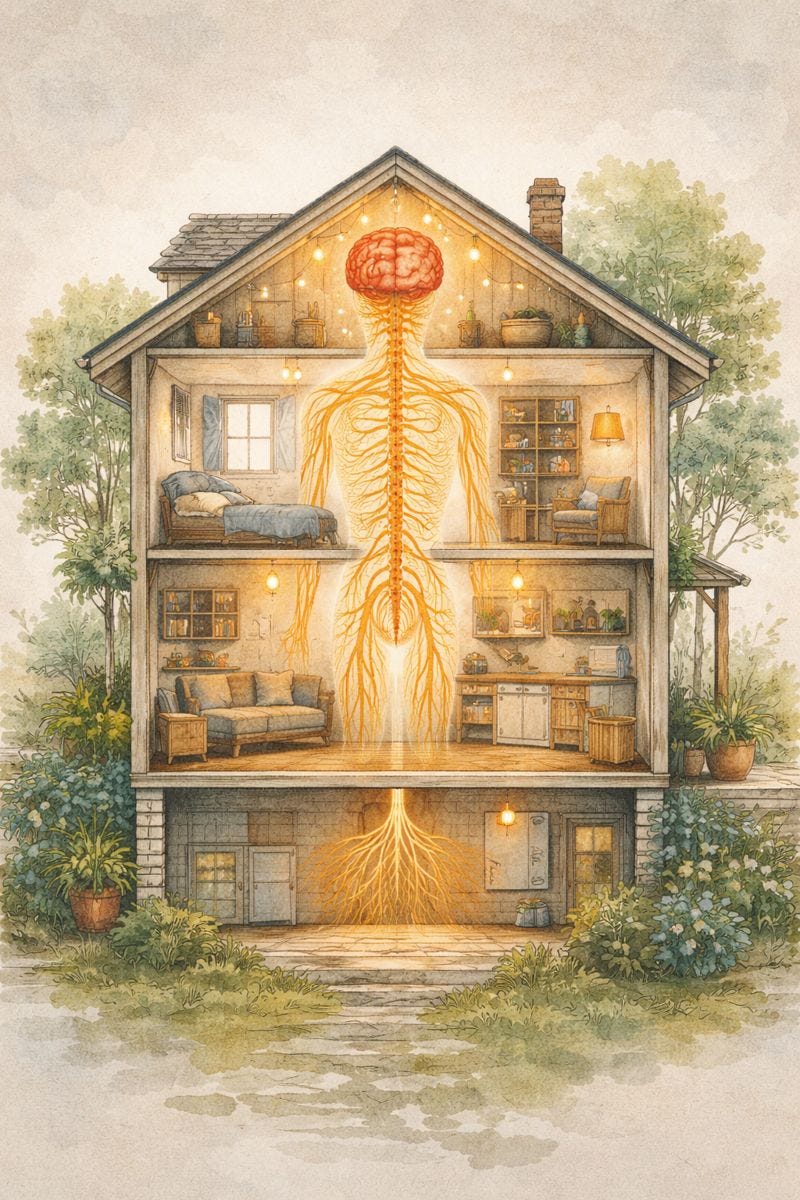
The nervous system is always in motion, rising and falling in response to context. It moves through blended states of alertness and rest, curiosity and caution. Most of the time, we are not fully activated or shut down. We are adjusting moment by moment. Orientation, acoustics, spatial rhythm, and visual complexity all influence how smoothly this pendulation occurs. When a space is legible, the brain does not have to work as hard to decide what matters. Regulation happens quietly in the background.
When a space allows bodies to orient gently rather than confrontationally, the nervous system does not need to stay on alert. Seating that is angled rather than face to face, shared points of focus, and layouts that support both movement and pause allow attention to settle. Sound becomes something the body can register without urgency. The reticular activating system no longer has to prioritize threat or novelty. The environment itself begins to carry part of the work that connection usually demands of people. It signals a shift from a state of survival-based hypervigilance to one of intentional, focused attention.
Home design often interrupts this rhythm without realizing it. A living room arranged for constant visibility can keep the brain subtly activated even during rest, as attention is continually pulled outward. A kitchen with harsh lighting, busy counters, or unclear zones increases sensory competition, forcing the brain to filter aggressively during routine tasks. A bedroom that doubles as a workspace sends mixed signals, preventing the nervous system from fully releasing into rest. A bathroom with cold lighting and exposed storage can turn moments of care into tasks that require alertness rather than offering relief. These conditions rarely push the nervous system into extremes. Instead, they create ongoing low level activation that flattens the natural rise and fall of energy.
The built environment is never neutral. Every room communicates expectations about how one is meant to show up. Bright lighting, exposed layouts, and rigid furniture arrangements signal that attention should remain outward and sustained. The brain responds by staying oriented toward monitoring and output. Over time, this can look like tension, distraction, withdrawal, or fatigue. What appears as disengagement is often a sensory system that has been asked to prioritize too much for too long.
Neuroaesthetic and trauma informed approaches shift the goal from control to cooperation. In a living room, angled seating, layered lighting, and a shared focal point such as a window or artwork give the visual system a place to land. In a kitchen, predictable pathways and clear zones reduce sensory competition and support gentle activation. In a bedroom, softness, containment, and visual simplicity signal the brain that filtering can relax. In a bathroom, warm light, enclosed storage, and tactile materials allow the nervous system to downshift during moments of care. These choices work with the brain’s natural filtering processes rather than against them.
This is also why decluttering alone often falls short. While reducing excess can lower visual noise temporarily, decluttering framed as discipline or perfection keeps the nervous system engaged in monitoring. Order becomes something to maintain rather than something to rest into. For nervous systems prone to shutdown, excessive minimalism removes sensory anchors that help attention organize and motivation emerge. Presence is not created by emptiness. It is created by meaningful, coherent input.
Feng Shui, when practiced beyond surface level styling, reflects this same principle. It attends to how energy, movement, and attention circulate through space. Proximity, rhythm, and repetition matter because the nervous system relies on patterned sensory input to feel safe enough to settle. Familiar pathways, stable furniture placement, and consistent gathering areas teach the brain what it can ignore and what it can trust.
Design that honors rhythm allows connection to persist even as capacity changes. Movement may slow. Attention may drift. Engagement may soften and return. A supportive space does not interpret these shifts as loss. It allows the nervous system to re orient without urgency. Seating within sensory reach, sightlines that allow witnessing without demand, and lighting that softens rather than stimulates all communicate that presence does not need to be proven.
When a space is designed with nervous system awareness, it becomes a quiet co regulator. Familiar arrangements and stable sensory cues reduce the need for self-monitoring. Over time, the brain learns that intensity does not always lead to rupture and that connection does not disappear when attention ebbs.
Attuned design does not manufacture intimacy or demand performance. It shapes sensory conditions so the nervous system can relax its grip on attention. When space carries part of the perceptual and relational load, people are free to arrive as they are. Presence becomes sustainable, flexible, and deeply human.