
The Performance in Your Home is Cancelled
Your Body Read the Room

Most people assume my work is about designing rooms. Really, it is about how much effort a room quietly asks your body to make.
People do not just exist inside spaces. Their bodies are constantly responding to them, often before they realize it. Light, sound, temperature, distance, and orientation are registered long before your conscious thought forms.
You can walk into a home that looks calm, clean, and even beautiful and still feel tired almost immediately. You might assume you are stressed, sensitive, or overthinking. More often, the nervous system has not received enough signals of safety to shift out of a state of alertness.
Before you have a single conscious thought, your body is already asking:
Where can I sit without being exposed?
Can I see what is coming toward me?
Is there somewhere I can rest my attention?
Do I need to stay alert here?
When a space does not answer those questions clearly, the body adapts. It braces slightly and stays on alert. That adaptation costs energy. Over time, that cost accumulates as exhaustion, even if nothing feels obviously wrong.
This is why people often feel drained in rooms that are theoretically “balanced.’

Spaces designed around a single way of sitting, focusing, or participating often fail to accommodate the range of human nervous systems. Conditions that appear “balanced” can still increase physiological demand. When an environment requires the body to suppress or override its own sensory and postural signals, the nervous system compensates by maintaining heightened vigilance.
Trauma-informed design shifts the focus from behavioral expectations to physiological response. It asks which spatial conditions allow the nervous system to reduce defensive activation and tension, while also supporting engagement and motivation when the system is under aroused. Rather than assuming a single optimal state, it considers how environments can modulate complexity and stimulation to support presence across a range of nervous system states, including hypoarousal AND hypervigilance.
Safety is not about enforced calm or stillness. It is about whether the body can sense enough support to feel safe. When a space offers clear orientation, gentle containment, and predictability, the nervous system no longer has to work as hard to protect itself.
I pay attention to where people naturally go. They lean against walls, choose corners, sit with something solid behind them, and stay longer in booths than in open seating. This is not preference or personality. It is physiology.
Having backing behind the body reduces unconscious vigilance. The nervous system does not have to keep checking for threat. Feng Shui has named this for centuries. Neuroscience explains the same phenomenon through a different lens.
Small design decisions matter. Furniture that is not rigidly centered, seating that offers a wall or solid surface behind the body, and arrangements that introduce conversation-encouraging angles rather than direct opposition all reduce physiological demand. Angled furniture supports co-regulation by allowing shared presence without confrontation, giving the nervous system space to orient, track others, and regulate simultaneously. When the environment does this work, the body can organize itself instinctively. Nothing has to be proven. Nothing has to be explained. There is room to arrive.
Lighting carries a similar message. Harsh overhead light creates sharp shadows and uneven illumination, which increases visual scanning and can keep attention oriented outward (monitoring the space) rather than on the task or conversation. Layered lighting distributes illumination more evenly across the room, reducing high-contrast zones and making the space easier to interpret without constant scanning.
Sound also shapes experience at a physiological and relational level. Hard, reflective surfaces amplify echo and unpredictable reverberation, which the auditory system can interpret as environmental instability. Softer materials reduce acoustic sharpness and background noise, lowering sensory monitoring and defensive arousal. When sound is supportive rather than flattened, it can also support warm attachment and motivation by making social cues easier to track. For nervous systems prone to hyperarousal, a well-tuned acoustic environment helps sustain engagement and connection without tipping into overwhelm.
Temperature and airflow often speak the loudest. Air should circulate gently instead of blasting. A room should allow a window to open, and it should make it easy to add a layer. Smell matters too. Olfactory signals reach the brain’s emotion and memory networks quickly, so stale air, concentrated odors, or strong cleaning fragrances can trigger vigilance or nausea before a person can explain why. Ventilation helps by reducing odor buildup and airborne irritants. These details communicate responsiveness. They tell the body it will not be ignored. Over time, these cues create a new reference point. Staying no longer requires endurance.
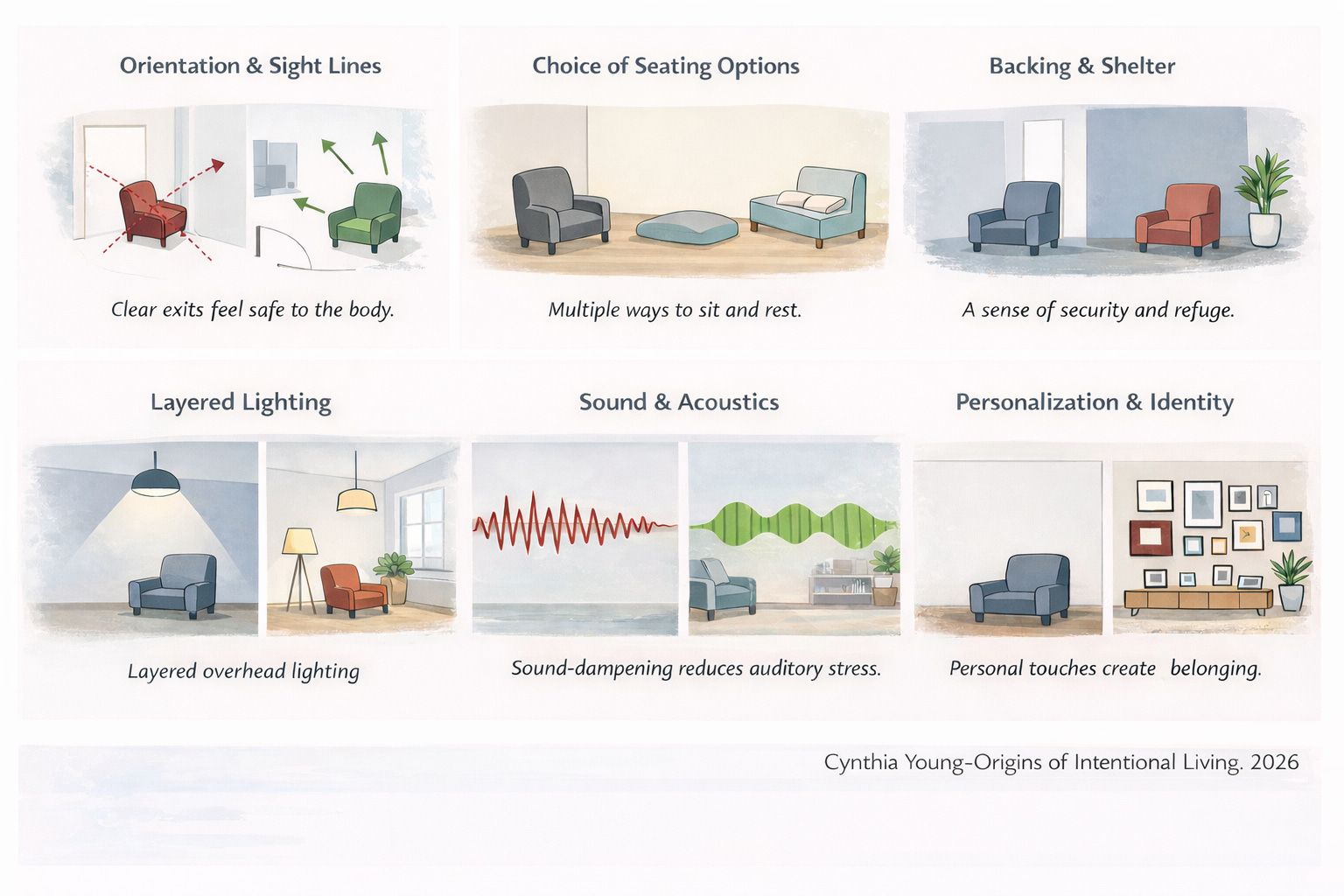
Many modern interiors are designed around a single mode of engagement. Sit here. Face forward. Sustain attention. Open plans, rigid symmetry, bright overhead lighting, and minimal variation privilege visual order and efficiency. While these environments may appear organized, they often lack the sensory modulation the body relies on to maintain internal coherence. Order to the eye is not the same as regulation for the body.
Calm designed as sameness can actually increase physiological load. When an environment offers limited variation in light, texture, orientation, or sensory input, it reduces the home’s ability to support different levels of arousal and engagement. A space that truly functions as a regulating system must be able to hold a range of nervous system states, allowing energy to settle, mobilize, or restore as needed across the day.
Regulation does not come from choice alone. It comes from a felt sense of relative safety and sufficient capacity. When the nervous system is chronically vigilant, choice can become another demand. The body cannot orient to options if it is busy monitoring for threat.
Supportive environments reduce unnecessary vigilance. They offer cues of safety, clarity, and support. As the body no longer has to stay on guard, capacity slowly returns. From that place, choice becomes meaningful again, not as pressure, but as possibility. The nervous system receives new information that steers toward belonging.
This is why certain details matter so much.
-Curves soften the brain’s threat response because they echo the body and nature.
-Varied ceiling heights subtly shift energy and cognition.
-Side daylight supports mood and circadian rhythm in ways overhead light cannot.
-Texture and acoustic softness ground attention before color even registers.
These are not aesthetic preferences. They are biological responses.
I once worked with someone who believed she had already created balance in her home. She was very excited to show me. She had a neutral palette, minimal decor, and everything aligned. And yet the moment she walked inside, her body felt vigilant, Nothing was “wrong” by energy standards. But it still didn’t support her. She was noticeably vigilant and her body was bracing. She was terrified at the idea of me touching anything. The energy load shift was teetering precariously.
What I saw: Her lighting was uniformly bright and overhead. Her furniture offered little backing. Her rooms had no obvious places to arrive or retreat. Her walls were blank in the name of calm. (minimalism removes sensory anchors) Her nervous system was adapting over and over the entire time she was home.
We did not overhaul the space. We layered the light. We softened circulation paths. We reoriented furniture so she could see exits and feel supported. We added personal objects, not clutter, but signs of her presence. Piece by piece, her energy shifted, not because the space became calmer, but because it stopped asking her to adapt.
What matters most to me is this: A home should not ask your body to perform, endure, or stay on alert. As well, it should not erase who you truly are and make you passive.
When a space is designed with nervous system awareness, it allows you to be present rather than always managing yourself. Attention can soften. Energy can circulate instead of being spent on vigilance. You can arrive fully, respond rather than react, and inhabit your life with more ease.
When a space truly works, your body knows. Not because it looks good, but because it lets you be there. Whole. Resourced. Available.
This helps to explain why I really dislike the "open concept" that is seemingly everywhere these days. My open kitchen is also full of granite and marble and hard surfaces, which jangle my nerves every time someone puts a glass down on the counter! We are adding softness where we can but it's challenging in a rental space! Thank you for so eloquently explaining this.
"How much effort a room quietly asks your body to make" — this reframe is everything. We think about spaces in terms of aesthetics, but the nervous system is responding to something deeper. A cluttered room isn't just visually busy; it's making demands your body has to process. No wonder we feel lighter in spaces that ask nothing of us.