
The Somatic Architecture of Your Living Space
A Home for the Body that Westernized Feng Shui Misses in Context

Since working at the intersection of design and nervous system work, I’ve been thinking about how our homes quietly shape the way we feel and function. We often talk about somatics, healing, and the nervous system, but we rarely talk about the architecture we’re living inside. Most Western homes lean toward straight lines and sharp angles, expressions of yang energetics. They’re efficient and orderly, yet they aren’t always what the body naturally softens around.
Our bodies are not angular. They are curved, fluid, soft, and rhythmic. We’re made of spirals, waves, branching patterns, and organic lines. When we spend our days inside rigid, boxy spaces, something in us subtly braces. We don’t always notice it, but our physiology does.
Somatics teaches us that the body desires flow, responsiveness, and the gentle containment that nature offers. Yet many modern structures emphasize straight lines, hard grids, and architectural uniformity. These spaces function, but they don’t always support the natural ways the body experiences ease or safety. Introducing softness and curves back into a space is not only a design choice. It is a way of cultivating a more attuned relationship with your internal world.
But it’s also important to acknowledge that how we perceive space is shaped by culture and historical experience. For some people, open layouts feel liberating and communal. For others, too much openness mirrors histories of surveillance, repeated trauma, or environments that never offered privacy or protection. Feng Shui offers beautiful insight, but even it can overlook the complexity of cultural narratives, trauma histories, and the different meanings that containment or openness have across groups. A supportive home must always be understood in context, because no design principle exists outside of culture, identity, and memory.
Your nervous system is always reacting to the world around you
Through neuroception, the autonomic nervous system is constantly scanning for cues of safety or threat, and that scan is shaped by lived experience. Harsh lines, clutter, sharp edges, and cold materials can signal alertness, especially for bodies with histories of vigilance. Warm textures, natural light, organic shapes, and visual harmony send a quieter message of “you can soften here.”
Rooms dominated by straight hallways, rectangles, and rigid furniture can subtly contract the body. Even when nothing is wrong, the space may not offer the cues associated with restoration. Curved shapes evoke something different. They echo the forms we recognize from the body and nature: bones and fascia, river bends, the womb, rolling landscapes. They feel alive and familiar.
A home becomes part of your system of support. Changing even a single element of a room can shift the way your body orients itself. A round mirror, a curved lamp, a circular table, or a softer rug can provide a sense of settling. A home doesn’t need perfection. It simply needs to welcome your body as it is: curved, dynamic, rhythmic, and organic.
Somatic cues in your living space
In somatic work, we learn that the body expresses emotion and memory through shape: tension, collapse, expansion, contraction. Homes do the same.
A cluttered entry can feel like a tight chest.
A windowless office can mimic shallow breathing.
A sharp, overstructured bedroom may feel like a clenched jaw.
A bathroom with curves and warmth can feel like an exhale.
An open floor plan or tall ceiling can cause feeling of unsafe or not being grounded.
a ceiling fan might feel cutting or frantic.
When you shift the shape of a room, you shift the shape your body takes inside it. The external architecture becomes somatic architecture. Rooms become metaphors for sensation.
Where does your home feel tight.
Where does it feel like a held breath.
Where does it feel like a long exhale.
Where does it mirror the body you want to inhabit.
Design becomes a form of somatic inquiry.
The Bagua Map: Insightful, but not complete
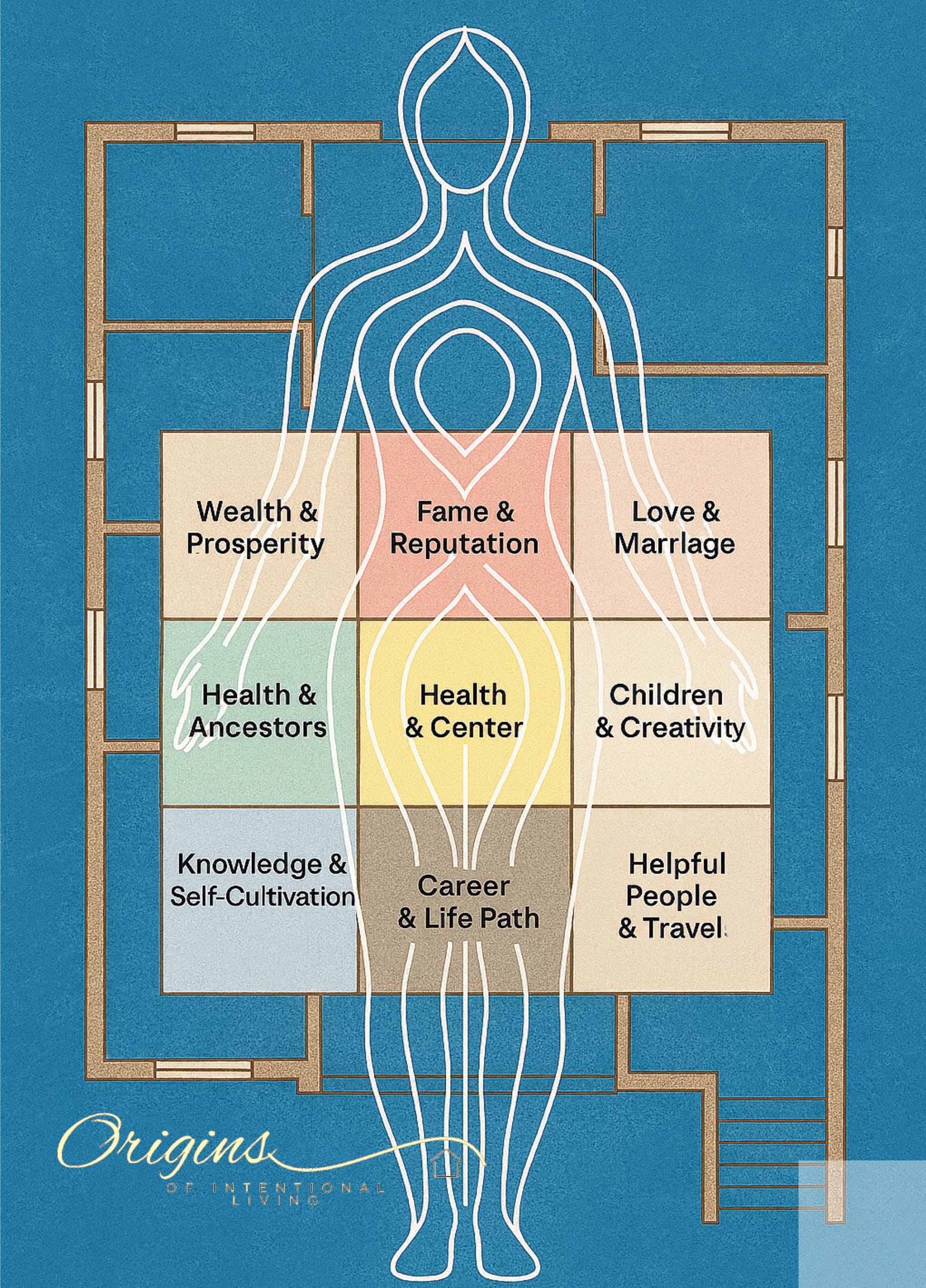
The Feng Shui Bagua map divides a home into nine energetic zones—health, wealth, relationships, creativity, grounding, and more. It acts like a symbolic body scan. The center reflects overall health, the back left relates to nourishment and metabolizing life, the front center speaks to movement and direction, and the right side represents relationships and communication.
When applied thoughtfully, the Bagua can reveal how your home interacts with your inner life. But it is equally important to acknowledge what westernized Feng Shui does not always account for. It emerges from a particular context with its own worldview, and it can overlook the lived realities of people whose histories include violence, suppression, systemic trauma, or familial instability. For some people, certain “design advice” recommended by westernized Feng Shui may not feel culturally resonant. For others, the idea of openness, emptiness, or minimalism may echo deprivation rather than abundance. Feng Shui offers wisdom, but it is not a universal nervous system map. It requires cultural sensitivity and adaptation.
Containment matters as much as openness
The issue is not always rigidity. Sometimes a home is so open concept that the body has nowhere to land. Large, undefined rooms can create a sense of chaos or exposure, especially for those whose histories have required vigilance or self-protection.
Defined seating areas, rugs, clusters of furniture, textiles, and screens can create gentle boundaries that allow the nervous system to settle. Bodies need both space and structure, and what that looks like varies dramatically depending on cultural background and personal history.
A home that meets all your states
Curved forms continue to offer support because they soften tension and evoke nature. But homes should not only soothe. A thriving nervous system engages in pendulation, a movement between activation and ease. Some people need more mobilizing elements like color, brightness, pattern, or defined pathways that spark momentum. Calm is not the only goal. Some bodies need uplift.
A supportive home understands the full range of human physiology and experience. Clearing a crowded entry can open a sense of possibility. Adding definition to an overly open room can create grounding. Warm lighting may nurture; bright light may energize. Natural materials can comfort; bold textures may awaken.
Rooms are not static. They respond to you.
Do they meet you where you are.
Do they offer steadiness when you feel scattered.
Do they offer energy when you feel flat.
Do they reflect your culture, your story, your history.
A home that holds your whole self
Your home is a living ecosystem interacting with your inner one. Nervous system awareness helps us understand how we shift through states of connection, activation, and protection. Somatic wisdom shows how deeply we respond to shape, space, and rhythm. Cultural and historical context reminds us that our responses do not emerge in a vacuum but are shaped by the experiences our families and communities have carried.
When these understandings come together, it becomes clear that a home is not meant to keep you in one state. It is meant to accompany you through all of them.
A home that can hold your full range becomes a partner. It softens when you collapse, steadies you when you seek orientation, and enlivens you when you are ready to mobilize. It offers enough structure to contain you and enough spaciousness to let you grow. It honors your memories, your identity, your lineage, and your body’s unique rhythms.
In this way, your living space becomes a place where your whole self is acknowledged, and where your life can unfold with the same intelligence and responsiveness that lives within your own body.
You are absolutely on point with the idea that feng shui - or any practice, for that matter - is not one-size-fits-all. I've studied feng shui quite a bit over the years, but have yet to hear how certain structures and placements can negatively affect those with trauma. Thank you.